All posts by Phil Brockett

Rev. James Anderson: Covenant Conflicts

Rev. James Anderson

Author’s Note: What follows are memories of one who has been in and about Evangelical Covenant churches all of his 80 years. Aside from consulting confutable memories, there has been no searching of archives for facts.

I was young, but not too young to figure out what was happening when scandal disturbed our bucolic Iowa farm community. A well-known young man had secretly married a divorced woman. I learned quickly that divorce was taboo, expected far away in Hollywood but not where we lived. It didn’t help that the man’s family had deep, founding roots in the Mission Covenant Church, or that he was part of our extended family. The couple stayed married to one another and part of that community the rest of their lives, eventually well-respected and admired, but they seldom appeared at my home church other than for weddings, funerals, and other obligatory events.

When I arrived at North Park Theological Seminary in Chicago in the early 1950’s, divorce was a hot button topic, stirring opinions right and left—one side proclaiming, “The Bible says. . . ,” others declaring, “But the Bible also says. . . ,” on and on. The source of those arguments was a promising seminarian who had informed seminary and church leaders he would marry a divorced woman, an unheard-of infraction of propriety if not actual rules that must surely block his being pastor of a Covenant church. In those dorm room discussions, most assumed he would move to a more liberal denomination, as had others who were unable to accept restraints of Covenant theology and practice. However, his great desire was to serve in Covenant churches, thus the dorm room discussions, pale reflections, I suppose, of heated confrontation in ministerial boards and seminary faculty meetings.
Casey Pick: “A Broken Family”

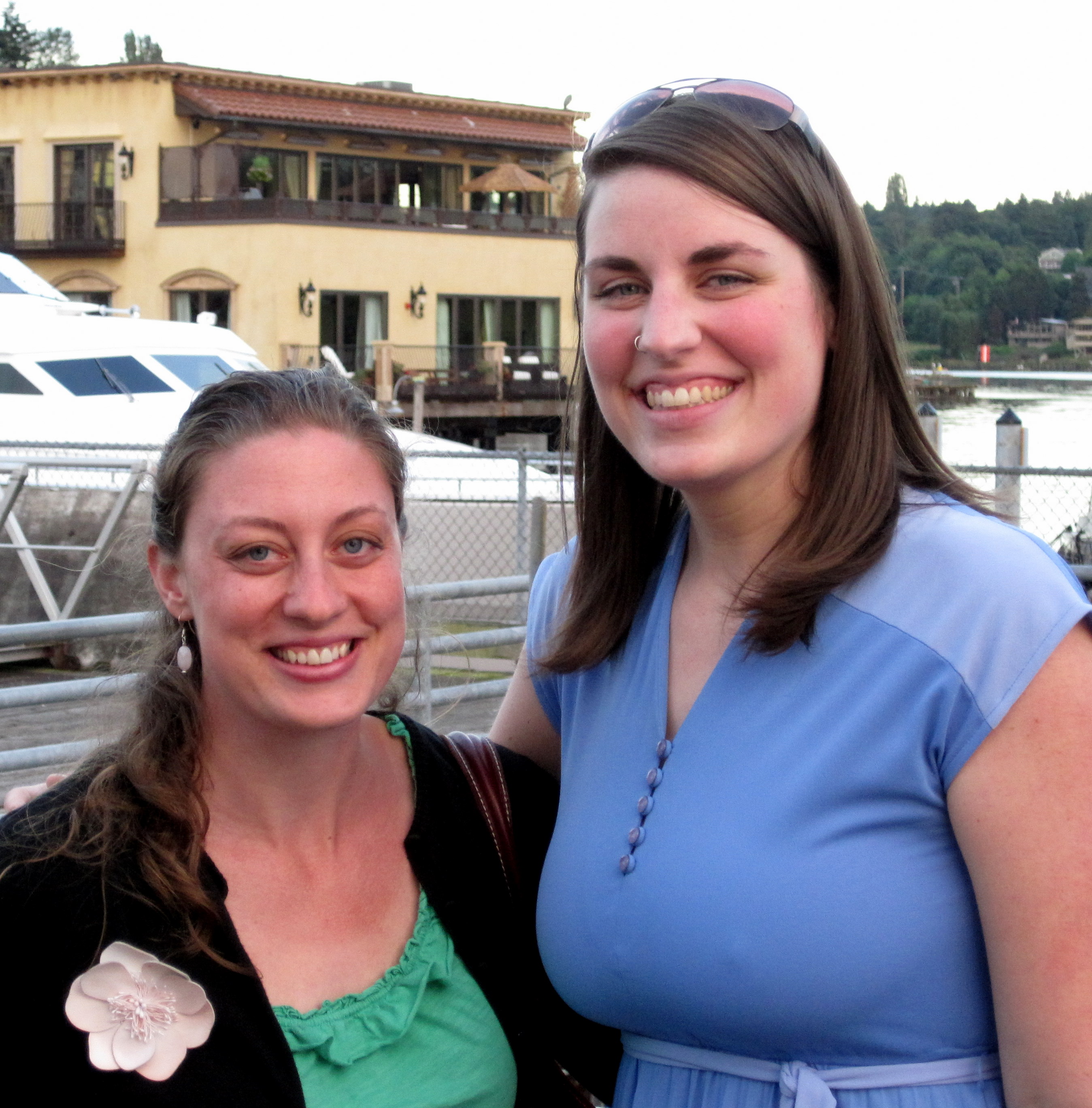
Casey and Amy (L-R)

Over the course of our friendship, Amy and I have discovered that we are in many ways mirror images of each other – very similar in some ways, and yet such complete opposites in others that it is faintly ridiculous and evidence of God’s presence in our lives that we are friends at all. Given this, it was fitting that we each independently discovered “Coming Out Covenant” simultaneously. She found it because of her lifelong affiliation with the denomination. I found it because of my work as a professional activist fighting on behalf of the gay, lesbian, bisexual and transgender community who specializes in outreach to conservatives and people of faith. Together we celebrated its existence, and speculated as to what this conversation could mean for the Evangelical Covenant Church that we both love.

It wasn’t until one day as Amy – further proving her mettle as a true friend – was helping me move that she told me she’d been waiting impatiently for my contribution to the site. I will never forget the look on her face when I told her I wasn’t planning on writing one, that I didn’t feel I could. You see, this is a website for people who consider themselves to be a part of the Evangelical Covenant Church – and I didn’t, not really. Not yet.

Amy Beisel: “Family Ties”

Casey and Amy (L-R)

Casey is my dearest and unlikeliest of friends. In college she was assigned to live in the dorm that I shared with five Christian women, in a suite affectionately known as the “God Pod.”  Casey was openly gay and openly hostile towards Christianity.  After the things some Christians had said to her — that God hated her, that she was going to hell, that she was an abomination in God’s eyes — who could blame her?

During the year that we lived together, Casey was curious about the fact that we worshiped God and that we respected her, that we loved Jesus and also loved her.  She joined us at our Christian fellowship meetings and tagged along to church.  We even did Bible studies together so she could learn more about the real Jesus, not the hateful God she had heard about.  But as Casey came to believe that Jesus was God and that He might even love her, we had to confront one final, urgent question: Could she be gay and Christian?

Rev. Paul Corner: “A Way Forward”

Rev. Paul Corner

When I first arrived at North Park Seminary, it was always a bit of a surprise to me how much the question of women in ministry remained an ‘issue’ for many congregations, lay people, clergy, and students in the ECC.  Having grown up in the United Methodist Church, I would jokingly say to classmates, “We were well beyond that at my home church.  People were more worked up over the lesbian couple that sat in the pew behind my family every Sunday.”  However, the irony for me in making that statement was that, as a child, I had no idea about the nature of their relationship, and I had no concept of the divide that existed in my church over their presence, participation, and leadership in our congregation.  The reality is that for me, homosexuality did not exist.  It was not something I encountered openly and regularly, and so it was off of my radar screen save for the cruel jokes and words pre-adolescents will call one another.

My first real encounter with the tension that exists between the LGBT community and the church came when I was a freshman at Penn State. 

Charlotte Johnson: “Staying Home”

L-R: Joan Gauthey and Charlotte Johnson

It’s hard to believe that “Coming Out Covenant” is truly up and running. I’m in my 70th year, and it has taken a very long time to acknowledge a large group of human beings living in our midst. I am one of them.

My name is Charlotte Johnson, and I live with my spouse, Joan Gauthey, in Washington, CT. We belong to Salem Covenant Church in Washington Depot, where we have been active for 44 years. When I say active, I mean ACTIVE. I’ve been in the choir since age 14, both of us have spent years on church council, Joan has been church chair, together we’ve been on Diaconate, Fellowship committee, Christian Education, pastoral search committee, Joan helped with nursery and I’ve organized Lenten Lunches for 20 years. SHOCKINGLY, we even headed the young people’s group when we were young and agile. (Some of those “kids” are now grandparents!) Oh yes, delegates to annual and conference meetings several times. Where we totally fall by the wayside is that neither of us bakes, and I’m a mediocre cook.

Joan has been a wonderful high school teacher for 35 years in town, and was coach of the year in Field Hockey in 1991 for the United States of America. Her Covenant resume is pretty thin. She’s only been in the church 47 years, is Irish, Arab and French, and was brought up in a Congregational Church. However, she did work with Jerry Johnson and the Barnabas group for several years. I, on the other hand, am a saturated “Covie.” My grandparents from Sweden helped start our church in 1888. My father was on the Diaconate for 40 years, and mother rolled enough bandages to circle the Congo. They put their blood, sweat, tears and constant prayers into our church family, as did Aunt Ruth, who lived with us and was always part of the family. Aunt Ruth was born in Sweden, confirmed in our church, and died at age 100 and buried by said church. My sister, 13 years older, and aunt went to North Park College (NPC) and Swedish Covenant Hospital (SCH) starting in 1924 – 1951.

Katie Klug: “Confronting Convenient Boxes”

(L-R): Leah and Katie Klug

So, Katie,” my group of peers began ominously, “what do you think of Greg being gay?”

All eyes were on me.

I was in high school and was widely known for being an outgoing, kind, hyper-involved straight-A-student.  I was the poster-child for excellence.  However, I was also a poster-child for an outspoken, opinionated and legalistic brand of “Christianity” that had no room for people who were gay, Mormon or having sex outside of marriage.  I’m actually still not sure where I latched on to some of those ideas.  Let’s just blame TBN and move on with the story.

Well,” I paused, “I like Greg, but I don’t think it is right.”

The classic ‘hate the sin, love the sinner’ routine.  How progressive I was!  I wasn’t from the backwoods; I knew that Jesus loved everyone.  I just (somewhat unconsciously) thought he loved me more for being a straight virgin who didn’t break rules and volunteered copious amounts of time to a plethora of organizations.

I was 13 when I first experienced the possibility and truth of a contextual interpretation of the scriptures.  My mother was about to become a pastor in the ECC and, though they did not seem consistent with the God I loved, I knew full well the scriptures that spoke against women in ministry and leadership.  How could my pre-teen brain reconcile this dichotomy?

Leah Klug: “Let Us Work Together”

Leah Klug

Last Tuesday, I stood in front of a class full of seminarians and made a presentation about how we would be imaging God in our class.  While I read scripture, I showed slides of classic Bible scenes as depicted by cultures all over the world.  Jesus was Korean, African, Chinese, Indian, White, European American, Sioux, Cherokee, Italian, Saudi Arabian, and Palestinian.  In my language, I spoke of what it means to open our imaging of God so that those in the pews can see themselves as created in God’s image. In my language, I asked them also to imagine that the gay, lesbian, bisexual and transgendered members of their congregations were also created in God’s image. I teach in a liberal, inclusive Jesuit seminary that has found a way to make room for Protestants from many denominations to study alongside Catholic students, and train together for work in ministry.

A year ago, I was a churchplanter in the Evangelical Covenant Church.  Shortly after my ordination in June 2009, I left the ECC church I had worked at for eight years to start a new congregation in Seattle’s diverse University District.  As my husband and I made it known that we would be planting a new congregation, the question came up again and again: would I be welcome at your church? Would my parents be welcome at your church? When people start asking if they would be welcome, if they would be safe in church, something is wrong. I knew I needed to step into God’s call on my life as a minister, and preach openly that all of us, gay and straight, are welcomed and celebrated in the God’s kingdom. Soon thereafter, we officially announced that the churchplant would be open and affirming.

Darlene: “My Journey as a Minister”

Darlene

I’ve contemplated the idea of sharing my thoughts about this topic for some time now – not sure whether I should or even could piece words together well enough to produce anything worth reading. This is mostly because I am still learning. I am discovering that it is possible to walk away from a careful study of Scripture and come away with a host of differing interpretations, and that I am not exempt from error. Not only that, but people who think differently from me can also be right.

I also must admit that I have some concerns (that border on fear) in sharing my thoughts. First, I worry that I will be misunderstood and even rejected by people I consider friends. Second, that I will become the victim of assumptions regarding my sexual status. I am a single heterosexual woman who desires to remain single indefinitely (I know that’s rare). I believe that God’s call for me is celibacy and I embrace that and celebrate being a happy and fulfilled single woman. As a woman for whom this is true, I risk being attacked by unwarranted assumptions and conclusions that many may draw regarding my sexual orientation. This is not because I frown upon those who are gay/lesbian, rather because of my utter dislike for assumption and misrepresentation. A third concern is that I will hurt those who read or that my thoughts may be misconstrued – my apologies in advance. And finally, I can’t help but consider that I will be misunderstood or have some distance placed between me and my fellow African American sisters/brothers because of what I say or refrain from saying in this brief space.

Nevertheless, I refuse to succumb to playing it safe, being held hostage in the prison of the personal opinions or objections of others. Jesus modeled risk-taking exceptionally well!

Rick Sindt: “A Little Space”

Rick Sindt

My name is Rick Sindt and I am a sophomore at North Park University, where I am currently pursuing an Art and Psychology double major. I grew up in a small town south east of the Twin Cities, in Minnesota, along the Mississippi River. I grew up with two loving parents and one brother. We lived in the country and always had an assortment of animals around ranging from barn cats to sled dog teams. I have a large extended family and I grew up much like any other boy. This past fall I started the process of coming out.

What has surprised me the most about coming out is that when I come out to people I am not given space to be me. People who I come out to still hold me to the image they had of me as a heterosexual, or they expect me to become their preconceived notion of who a gay man is. I first started telling people in September of 2010. The first person I told was one of my closest friends. I decided to tell her because she continued to ask me about girl interests in my life. I grew tired of putting on a charade, I felt like I was living a lie, and I knew the only way to liberate myself from that feeling was to name my sexuality to someone. She handled it well and graciously. At the time she was alone with me in this journey and it was difficult for her to be the only one who knew. I was finally willing to talk about my sexuality with someone and I talked about it persistently.

Michael Satterberg: “My Story”

Michael Satterberg

It is the stories of others that help promote dialog and understanding.  Most people that I know who have once held anti-gay viewpoints but changed their view on the subject, whether their anti-gay view was based on religious convictions or not, have stated that it was personally knowing someone or hearing someone’s story that made them think about the issue in a different way.

Here is my story:

I was born in 1981, so much of my childhood was during a time when LGBT individuals had no or very little positive presence in the public sphere.  Although not everyone does, I knew that I was gay from a very young age.  I knew I was different and that this difference was not accepted in society and especially not in the church, so I kept it all inside and told no one of my feelings.

I come from a line of deep rich Covenant blood.  I am almost 100% Swedish and can trace many of my relatives back to Sweden (for non-Covenanters, the Covenant Church was founded by Swedes).  There have been numerous Covenant clergy in my family history dating back three or four generations.  I attended church every Sunday and unless I was on death’s doorstep, I was there.  I attended a Covenant camp in the summers and even worked at one during a summer in college. I went to CHIC, and then completed the perfect Covenanter’s journey by going to North Park University.  Throughout all this, I prayed to God to fix me, or heal me, or change me.  I wondered what I had done wrong to be so different from everyone else.  It seemed like a cruel joke.  I thought maybe if I prayed harder, or was a better Christian, God would make me “normal.”  Nothing changed so I just put on the happy perfect Covenanter mask and continued living.  This only lasted so long before resentment and anger started to brew, and eventually I distanced myself from the Covenant and stopped attending church altogether, but never completely abandoned God.  I always knew that even though I might leave a denomination, I could never turn my back on God or deny his existence or presence in my life.