“Above the Influence” (sermon excerpt)

Andrew Freeman

Several weeks ago, I had the honor of preaching at North Park University’s Sunday evening service, collegelife. At the time of the invitation all I knew was that they were beginning a series on characters in the Bible, and how we can “mind the gap” of 2,000-plus years between their time and cultural context and our lives in our world today. How can their lives, experiences, and stories inform us in the similar challenges we face today? Only later did I learn the specific topic for the night I was asked to speak: “living above the influence.” I was less than enthusiastic. It seemed to have old youth group “peer pressure” talks written all over it. They picked the wrong guy for this one, I thought.

I had to choose a character that exemplified a life above the influence. So I picked Peter. Yes, Peter. Impetuous, imperfect Peter. Peter, the one who stepped out of the boat in faith, and then sank. Peter, the one who vowed to follow Jesus even unto death, and then denied his Lord three times. In many ways, Peter was such a doofus. And in many ways, Peter was just like you and me. He sank. He denied. And still he was called the rock on which the early church was built.

Peter was a loser of a fisherman, not among the social elite. He didn’t hesitate at Jesus’ invitation to be a part of his inner circle. Just like us, Peter wanted a place to belong, he wanted to be accepted. But this desire for belonging would take over him in such a way that in order to fit in with an accusing crowd, Peter would have to deny his faith. And as with Peter, our innate desire to belong easily becomes idolatrous, which compels us to compromise.

I’m afraid the same is true in the Church, that great fellowship and place of belonging. All too often, we feel forced to compromise or to cover up truths about ourselves in order to find acceptance and welcome. We advertise with the message, “all are welcome here” while often communicating an implicit message that some are welcomed as second-class members. And so, for many the options appear to be to hide and remain accepted, or to be honest and face rejection. It’s no wonder that so many of our sisters and brothers sitting in the pew next to us are, in fact, hiding in plain sight. This has become the price of fellowship. It is denial. Just like Peter. Denial of one’s very identity.

When it comes to relating with members of the LGBT community, we like to disassociate ourselves from the purportedly Christian churches whose vitriolic speech communicates hate more clearly than love. But when we welcome others without offering them the freedom to be honest about who they are, and together celebrate and embrace all that God has made them to be, we too fail to communicate the radically inclusive love of the Gospel. Instead, we find that we’ve fallen under the influence of a culture of mere tolerance. Tolerance is convenient. Tolerance is cheap, and it is easy. But tolerance is not Gospel. Tolerance is a denial of the Gospel.

In striving to live above the influence, we must continually return to our baptism, to remember who we are and be thankful. This is the Good News of the Gospel: you are accepted. There is no second-class citizen in God’s Kingdom. There are no second-class seats at Christ’s Table. I refuse to tolerate second-class membership in Christ’s Church. And I refuse to deny the radical love and acceptance of the Gospel.

Here is a 17-minute clip from the second half of the sermon I delivered at North Park (complete with my sniffles and strained voice as I struggled to preach while at the peak of a cold!):

[audio:http://dl.dropbox.com/u/3181966/collegelife022011%201.mp3|titles=”Above the Influence”|artists=Andrew Freeman]

If you are interested, you can listen to the full sermon, about 38-minutes (which includes an introduction and the beginning of the communion liturgy), in the player below or download the audio file by clicking this link.

[audio:http://www.npumin.com/content/podcast/collegelife022011.mp3]

Rebecca: “My Story”

Rebecca

I was 20 when I first heard someone say that God might be OK with me even though I’m not straight. I spent the next two years at North Park as a transfer student, trying to figure things out on my own. I really felt that there wasn’t anyone I could share it with at the time. In high school and my first bits of college I had done a lot of spiritual leadership-y things – led a prayer group at school, led a lot of worship – and I felt that I had trapped myself. I did well in school, I led all these things, but privately I was lonely and intensely sad. I was deeply unhappy (but it did make for some good songwriting material). I could not believe it was possible that God, my family, my churches, or most of my friends would ever accept me. It hid parts of who I was; I could never just let go, be a friend to my friends, be open, be myself.

I didn’t have anyone to go to with something so unimaginable and unacceptable – I say unimaginable because when I first started coming to terms with my sexuality, I really honestly could not imagine what my life would look like – it was terrifying. So when I got to North Park, I kind of tried to stay under the radar. I was torn because I was encouraged in doing things with the church, but at the same time I felt that if I was honest with people, that my orientation would cancel out all of that. Covenant churches were spaces where I felt that if I got close, if I was known, it would necessarily lead to pain and rejection, so the easiest thing to do was back away.

Rev. Arthur Nelson: Prayer

Rev. Arthur A. R. Nelson

Over many years my heart and soul have been churning with the desire to enable release and freedom for those in our Covenant family who have carried the pain and sorrow of the misunderstanding of their sexual identity and orientation, and in particular their disappointment with their church continuing to send clear signals of judgement and separation. I am deeply grateful that the current dialogue is finally become broadly public, which can only lead to a healthier and more loving Covenant family.

Here is a prayer that I wrote for my recent publication – Prayers Public and Personal – in its original form.

Holy and Compassionate God,
bless with your abiding presence and sensitive, loving, and faithful friends
those whose loneliness is deep and dark by virtue of their being
misunderstood and rejected.

Knowing that the issue of sexual identity too easily leads to the hasty
prejudice of others and sorrowful self-judgement, in the name and power
of  your son Jesus, who had unusual and unconditional love for those
often ostracized and moved to the margins of the culture of his time,
bring your refreshing and healing Spirit to those persons whose soul and heart
have embraced your saving grace but find your church and society
unkind and demeaning. And help us to keep reminding them that they are
dearly loved by us and by you.

Amen.

Nathan Albert: “Belong, Believe, Become”

Nathan Albert, The Marin Foundation

During my years working as a professional singer and actor I was often quiet about my faith, especially around my countless gay or lesbian friends.  I quickly learned that their experiences with the Church and Christians were almost always negative.  Many were kicked out of their churches, shunned by family members, and even spit upon by Christian roommates.  They didn’t have a positive view of Christians or the faith we professed.  From their experiences, I saw that many churches excluded rather than included LGBT people, had a closed-door policy rather than an open-door policy, and taught a type behavior modification rather than Gospel transformation.

These churches worked on the model of Behave, Believe, Belong.  Christians have told countless LGBT individuals that they must behave a certain way (be celibate or become heterosexual), believe a certain set of doctrines (this is right, that is wrong; this is sinful, that is holy), and then they are allowed to belong to the church community.  My fear is that this model might actually be more damaging than helpful.  My fear is that this model can distort our understanding of grace and our understanding of God.  My fear is that this model might force us to think that if we behave a certain way, believe a certain thing, then God will accept us.  Or worse, I fear that people will give up on God entirely because they are forced to behave rather than belong.

This is a very religious attitude.  Religion says we negotiate with God to try to get help in exchange for our good behavior.  We do what were told and, hopefully, God rewards us.  Because of religion in churches, we’re told you must be a certain way, act a certain way, behave a certain way, believe a certain doctrine, then belonging to our community can happen.

Instead, I think the Gospel presents a better model: Belong, Believe, Become.

David: “Standing on Uncertainty Lane”

God asked Solomon a question that I wish God would ask me:

“What shall I give you?”

Up until recently, if I was asked this question by God, my answer would have been, “Free me from homosexuality,”  “take away this deep desire for me to be with another man.”  In my time spent in prayer, I was like the persistent widow constantly asking God for this. This plea has not “yet” been answered.   I say “yet” because I still hope that some day I will wake up and find myself attracted to the “GIRL-next door” instead of the “GUY-next door.”

This desire has intensified over the past couple months as I’ve found out that two of my closest Christian friends are engaged to be married.

Is this a selfish wish?  Is this a wish that is in line with the word of God?

I am a Christian man, born, raised, and worshiping in the Covenant Church, who also happens to be sexually attracted to other men.  I don’t like calling myself “gay,” because in my town, people (both inside and outside the church) associate “gay” with words like  “promiscuous,” “flamboyant,” and “queen.”  I do not fit any of these categories.

In my few failed attempts to connect with other gay men, I hesitate at calling myself a “Christian” because people outside the church (both gay and straight) associate “Christian” with words like “judgmental,” “hypocritical,” and “self righteous.”

For me, trying to find my own identity is incredibly bewildering.  Scripture and prayer has been an incredible source of comfort and guidance for me as I search for my identity. However, on the topic of homosexuality, it is lacking clarity.   “Mom” reads it one way; “Dad” reads it another way.  When getting an answer, I’d like to always go to the parent who will give me the answer that I want, but I’ve learned that neither “Mom” nor “Dad” is always right.

Graphic by David

Since these answers are unclear to me, I feel like I am standing at an intersection on “Uncertainty Lane” not going anywhere in life.  I am scared to pursue an intimate relationship for fear I will mess it up, and I am scared to share the Gospel with non-Christians for fear that I will be hypocritical or give people an inadequate image of Christianity.

In addition to the voices from the “Christian” community and the voices from the “gay” community influencing me, I also struggle with a very judgmental father and a mother who I love and do not want to disappoint.  I know from experience how bad decisions can hurt those people that you love, and I fear that a wrong choice on my part could deeply wound the people who I love the most.

Nancy Carlson: My Story

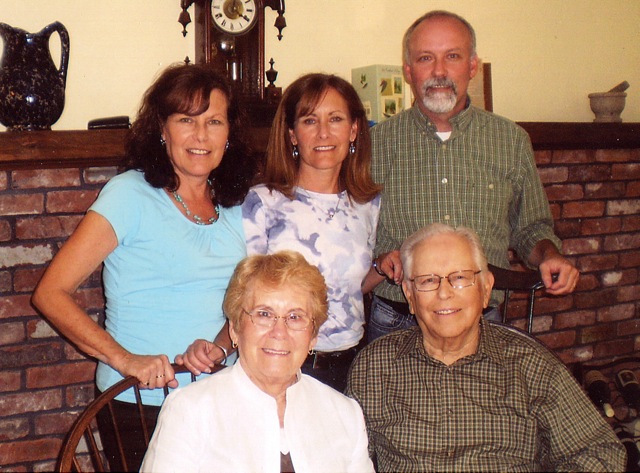
Carlson Family: (seated) Nancy and Al, (standing L-R) Pam, Cindy & Jim

I am a mother of a son who is gay.  I would like to tell you my story.  I was brought up in a Christian home and have attended the same Evangelical Covenant Church all of my life.  My grandfather was a founder of our local church in the late 1800’s.  I met my husband there.  We have three grown children:  two daughters and a son.  Our involvement at church has always been an important part of our lives and it still is.  We both sing in the choir and have served in many different capacities.  It was 19 years ago when our son, Jim, moved into his own home that he had just built.  I began to notice that he seemed lonely, sad and distant.  Of course, I was praying that he would meet a nice Christian girl.  He had many girlfriends but, one by one, they were getting married.

As a mother, you know your child.  I knew that Jim was deeply unhappy.  I mentioned to my daughters that I was concerned.  For the first time, I began to question Jim’s sexual orientation.   One night, I was so concerned for Jim that I could not sleep.  I went into the den and knelt down and cried out to God.  First of all, I prayed for Jim, asking God to surround him with His love.  Then I prayed that God would restore Jim’s sense of peace and joy.  Finally, I prayed for myself.  If Jim was gay, how could we accept this?  I was taught when I was growing up that the Bible says that homosexuality is a sin.  How would our church handle this?  What would our friends and family think and say?

Anonymous: My Story

As I’ve been reading the posts and comments here, I’m excited to see new dialog within the Covenant. I’ve seen views across the board about us. We are people, not an issue.  I am gay and a child of God.  These identities can and do coexist.

I have been a Christian all my life, and there was a time when I myself was strongly against what was already evident inside me.  I held it in the dark, too afraid of what might happen if my secret was out.  I must admit, though, that my fear did not come from the pulpit – well, maybe a few I happened to see on TV.  The pulpits were mostly silent about us. Instead, the hate, anger, filth, and outright lies came from the news, TV, and from movies. Most of all, it came from everyday people around me: from family, friends, and strangers. From those who suspected I was gay, it was the taunting and torture just about every day of my grade school and junior high life.  I’d been singled out and attacked, and I was constantly taunted by fellow students.

The taunting was still a problem in high school, but I made a small group of friends and stayed away from any extracurricular activities.  I limited myself to one activity outside of school: being drill leader for JROTC.  The rest of my time I chose to work instead of doing other school activities.  I worried this might affect me down the road when applying for college, but it wasn’t worth the risk to me.  Being out simply didn’t feel like an option.  My group of friends from high school never even knew until a couple years after I graduated from college.

Denny Moon: “Saved”

Rev. Denny P. Moon

All I could hear was the deep breathing and occasional snore of the students asleep in the back of the van.  As a youth pastor I was taking high school students from New England to visit North Park College.  The young man in the passenger seat next to me, the only other person awake in the vehicle, asked me in level tones just audible over the radio, “Does Jesus really love homosexuals?” I was just glad to have him talking, helping me stay awake until we reached the hard comfort of a floor in the Covenant church in Youngstown, Ohio. I paused to think before responding. “Yes.”  I spoke slowly. “I think he has to, because he loves everybody just as they are, without changing anything.  I mean that’s basic Christian stuff.”

Frankly, I didn’t want to say any more than that, because I was afraid he might take my words home to his parents and I could get in trouble. I ignored the obvious questions: “Then why does our church call homosexuality a sin?” “Why does no one ever talk about homosexuals at church?”  “Why do Christians condemn homosexuals?” I just let it ride. For several moments we heard only the periodic thump of the wheels over the uneven asphalt sections of the Pennsylvania Turnpike.  “Oh,” he said, “I just wondered.”

Had I been a better youth pastor, I would have asked him some open ended question that would have helped him understand his wondering, but I didn’t.  He sensed my fear and stopped talking.

Ten years after the van conversation I had moved to a new church and the questioning young man drove two and a half hours to have lunch with me.   I was glad to see him and relive memories of our times together.  But there was an urgency about him and over our greasy pepperoni pie he told me he that he was gay and had come out to his family.  Our eyes were full and his anxiety palpable.  He said, “I came here to thank you for saving my life.”  I said, “I didn’t save your life, you did.”  “No,” he said, “There was more than one time when I really wanted to take my own life, but I remembered what you said ‘Jesus loves homosexuals… just the way they are.’ These words saved me.  So… thanks.”

Surrendering Perfection

Last fall, I wrote the following letter to my family on Thanksgiving. I share this letter here, especially mindful of those families with LGBT children. But I also share it because, though it may be addressed to my biological family, the message is equally one for my church family, my ecclesial family.

Over the past several weeks, I’ve listened to some of my friends relate their feelings in anticipation of going home for Thanksgiving. Some are excited: because they love and miss their family and can’t wait to see them again, or because this is the first time they’ve been welcomed home for a holiday in years. Some are ambivalent about family time, because they expect to sit quietly and peacefully coexist without really talking about the stuff of life. Others are downright anxious about going home, fearing harsh words, difficult conversations, and judgment. And some won’t go home at all, either because they’re not welcome or they’d just rather avoid the awkwardness and spare everyone the difficulty. All of my friends’ feelings in relation to their parents and family – excitement, ambivalence, fear, anxiety – stem from the fact that these friends also happen to be gay.

Nathan Albert: “What is the Loving Thing to Do?”

Nathan Albert, The Marin Foundation

As a North Park Seminary student, I have spent the last ten months writing my thesis, which looks at the relationship between the Evangelical Covenant Church and homosexuality.  I have exegeted all the “clobber” passages, have read and reread the current documents the ECC has written about sexuality, and have read any book I can get my hands on the subject of faith and sexuality.  I also work for a non-profit that works to build bridges between the Lesbian, Gay, Bisexual, and Transgender (LGBT) community and the Church.  I provide pastoral care for countless youth who are coming out, parents who have gay children, and churches that seek to dialogue about this controversial subject.  I live in the gay neighborhood of Chicago and long to show the beauty of Love and Grace to my countless gay friends who have given up on God.

For years, my views on homosexuality were conservative.  But now, after life has unfolded, after reading Scripture over and over, after consulting every commentary I can get my hands on, after years of studying and praying, and after befriending so many gays and lesbians, my views are changing.